A / Feature Referee
Feature selection for machine learning.
What should enter the model? Compare candidate inputs with the same starting model, or baseline. See which earned statistical support before investing in the next build.
Feature selection for machine learning
Machine learning makes predictions: how much inventory will sell, which transaction may be fraudulent, which machine may fail. Better predictions can mean less waste, fewer losses, and better decisions.
People and AI agents can propose a thousand possible improvements. ML Referee evaluates up to 1,000 candidate features—the clues a model uses—in one run. Its independent statistical assessment helps you choose inputs, investigate a model’s decline, and see where more data could be worth the investment.
01 / Where Referee enters
Referee fits at the evaluation stage: your team has a starting model and ideas for improving it. Before building around those ideas, test what they add.
The result supports a practical decision: what to build, what to repair, and what to investigate next.
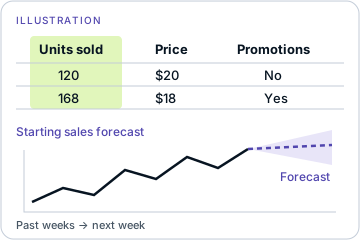
Learn from historical examples to predict a measurable outcome.
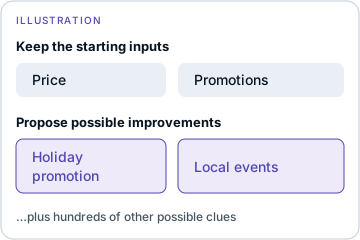
People or agents suggest new clues—features—that might improve the prediction.
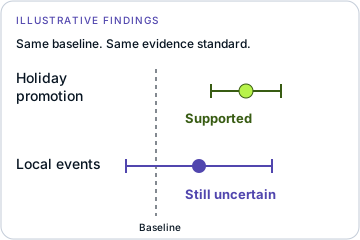
Test the full candidate family against the same baseline and evidence standard.
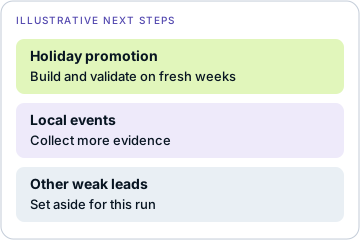
Advance supported ideas, focus the next experiment, and deprioritize weak leads.
02 / What Referee does
A / Feature Referee
What should enter the model? Compare candidate inputs with the same starting model, or baseline. See which earned statistical support before investing in the next build.
B / Model Repair
What changed when it stopped working? Compare stable and degraded periods using signals you supply. Investigate changed relationships and bounded repairs worth testing on new data.
C / Research priorities
Which uncertainty is worth resolving? An unresolved feature is not automatically a dead end. Use its evidence and limitations to focus data collection, refine a proposal, or plan the next experiment.
03 / The hidden trap
Every submitted candidate faces the same declared baseline, observations, and validation design. No candidate gets an easier test.
Testing hundreds of features means some can look useful by chance. Referee evaluates the complete declared feature family together and applies family-wide error controls, reducing false discoveries under the stated assumptions.
Each candidate keeps its measured effect, statistical strength, uncertainty, limitations, and next confirmation step.
The evidence bar is chosen before the results arrive. Referee then keeps supported, provisional, and unresolved findings distinct, showing both what earned belief now and where further research could resolve a useful uncertainty.
04 / One fair review
Agree on the outcome, starting model, candidate inputs, and required strength of evidence. Specify which information was available when each prediction was made.
Check that required columns are present, required values are valid, and labels are used only after they become available—before the run consumes credits.
Compare up to 1,000 candidates with the same baseline and evaluation design, without coordinating a separate ablation job for each feature.
See which features cleared the declared bar, which remain provisional, and which were unresolved. Prospective confirmation remains part of the work.
05 / Evidence in practice
Referee supported an augmented model’s predictive improvement over the default baseline. Separately, the demonstration measured 64 additional unsafe prompts detected and 11 additional false alerts at independently calibrated, frozen thresholds. An added feature’s incremental value remained unresolved: a question for further research, not an automatic rejection.
Read the case study and limitations →06 / The decision
The report connects evidence to the next investment. Your team can advance supported inputs, test a repair, or gather data to resolve an important uncertainty. It supports your decision; final model training and validation on new data come next.
07 / Where it fits
A strong fit when
You have a measurable outcome, a starting model, historical examples with known answers, and candidate inputs to test. This includes forecasting demand, detecting fraud, ranking search results, and predicting customer churn.
Not ready yet when
If those pieces are missing, begin by defining the outcome, assembling suitable data, and establishing a baseline. The practical introduction explains how they fit together.
08 / How to use it
Research and model-building agents can discover Referee, check readiness, preflight evidence, obtain a quote, submit an evaluation, and return structured results for review. The proposing model can change; the evaluation contract remains explicit.
Teams that prefer direct integration can use the same authenticated service through its HTTP API or thin clients. The public website is informational and does not accept datasets.
Today, an agent can quote and submit calls within an authorized beta-credit pool. Planned paid access will let a human approve an allowance and boundaries so the agent can purchase credits and proceed without approval before every call.
The human-defined spending policy remains the authority. Planned x402 support will provide the programmatic payment rail; calls outside the approved allowance, per-run ceiling, or expiration will stop for human review.
Bring one prediction problem to the free, invite-only beta. Tell us what you want to improve and how evidence would change your next step. People and connected agents can request access; approval is manual.
Request beta access